Are “Big” Words Ableist?
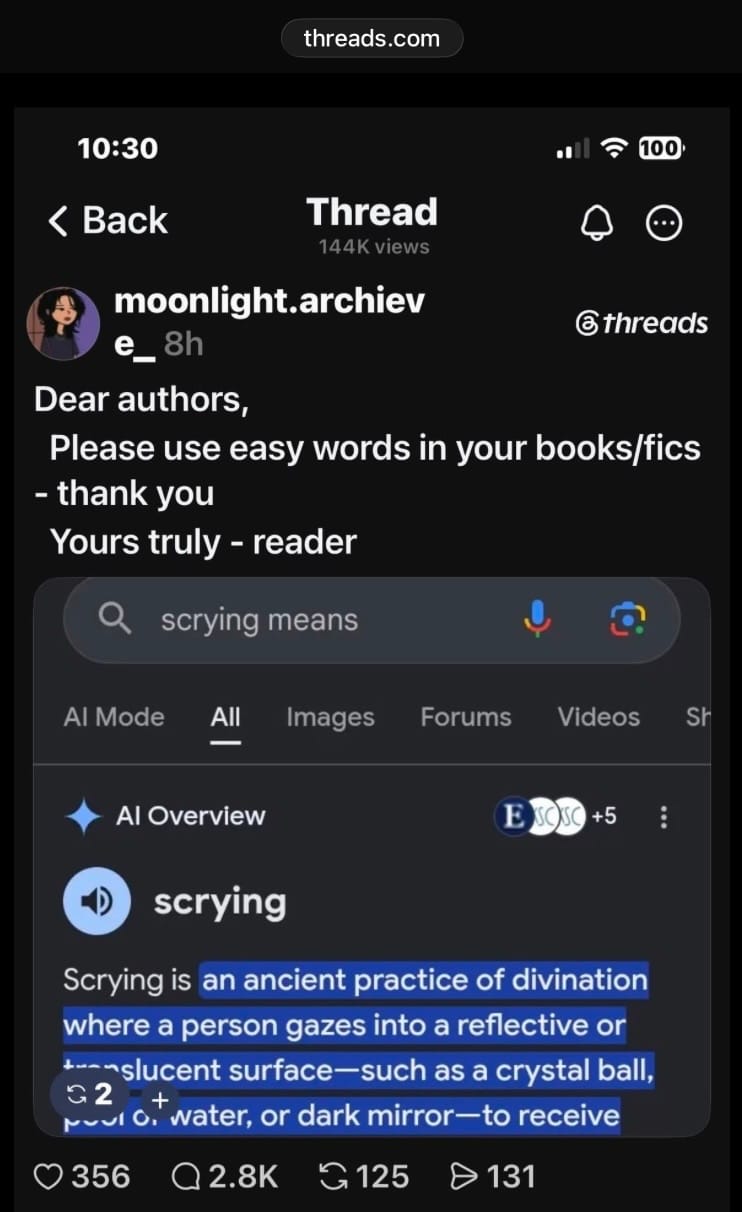
Threads user moonlight.archieve_ started a little bit of a kerfuffle this week when they came out with an absolutely inane little take that set off a myriad of social media discourse accounts raising the question of “Are authors ableist for using big words in their writing?” Quite frankly, I’m feeling a little bit dumber even just being exposed to such a question, as it seems to radiate stupidity particles. (Quick, hold your breath.) The exact post from moonlight read, “Dear authors, Please use easy words in your books/fics - thank you Yours truly - reader” Accompanying the post was a screenshot of moonlight’s search for the definition of a common fantasy word used ubiquitously throughout the genre: “scrying.”
Despite that this screenshot has provided evidence that moonlight is capable of looking up definitions on Al Gore’s Internet, apparently the unlimited access to exact meanings and even etymologies is not an acceptable solution to finding unknown verbiage. They would prefer not to discover at all. I think I can definitely relate to most of the readers out there when I say that I used to have a book open in front of me and a dictionary open beside it. Discovering the meanings of words based solely on contextual usage was also part of the development of my critical thinking skills. Apparently, the solution to the issue of finding “difficult” words in books or fanfiction is to simply require (or at least request) that authors utilize a simpler vocabulary and eschew anything that might place undue hardship on those who’ve succumbed to the stupidity particles.
Naturally, the majority of Threads (and other platforms) disagreed with this take, as is the normal kneejerk reaction to something so utterly braindead that the rational side of our minds should see it as a joke. Of course, since there are millions of people muddling around online whose brains have transformed into a gelatinous ooze of useless sludge powered by therapy-speak and social justice buzzwords, there was at least one person who decided to take up the torch of this argument and prove to us all that there really is no God and we truly are alone and suffering. This person happened to have a decent following and relatively impressive resume, though neither of those things seem at all to be indicative of a person’s ability to use reason and logic in their day-to-day lives.
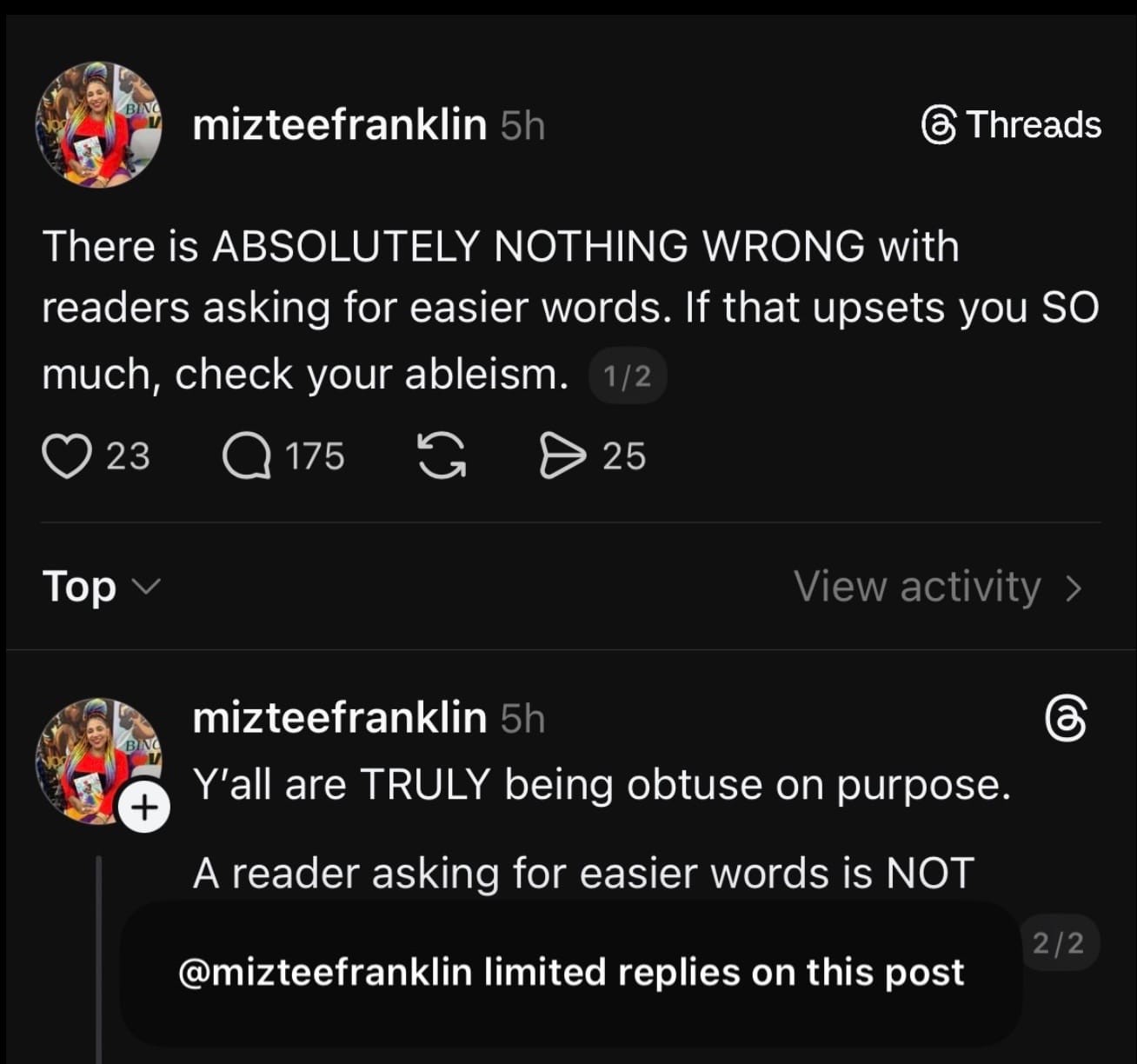
“Award Winning Writer” Tee Franklin (known on Threads and other SocMed as mizteefranklin) who has written for Marvel, DC, and Image Comics chimed in with a nice little collective accusation. “There is ABSOLUTELY NOTHING WRONG with readers asking for easier words. If that upsets you SO much, check your ableism.”
♪ ♫♩ — I’m sorry Miss Franklin; I am for real. Never meant to make your readers cry, I use hard words very much like “scry.” — ♪ ♫ ♩
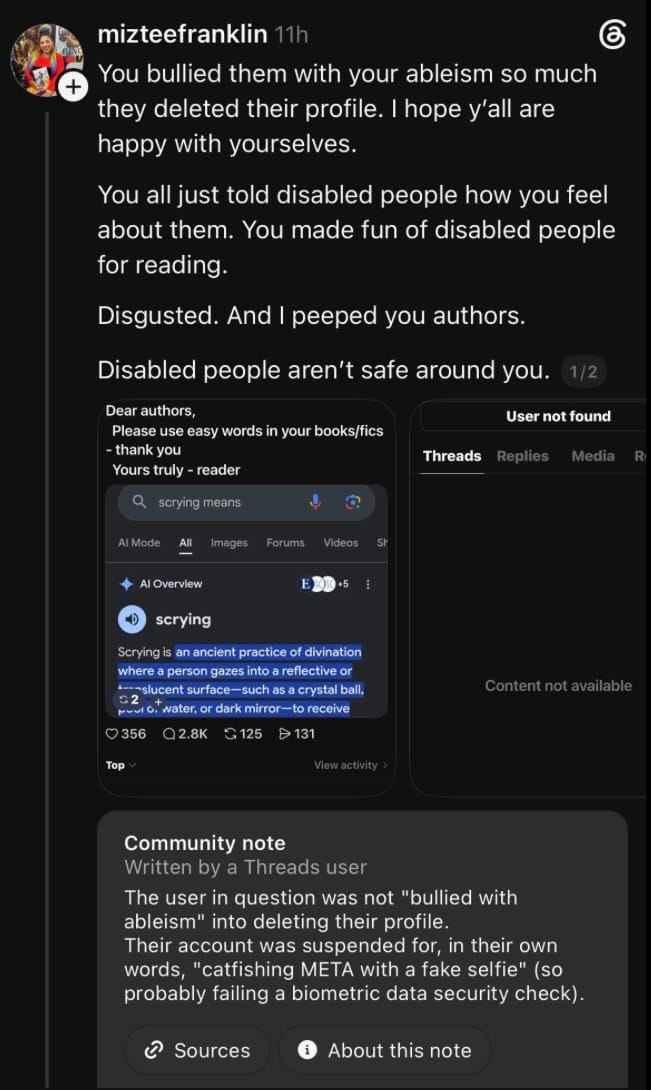
Moonlight’s profile disappeared after a short time which was rather inconvenient since it appeared as though they had deleted their profile due to the “backlash” they had received from the post. Franklin even weighed in on that, writing: “You bullied them with your ableism so much they deleted their profile. I hope y'all are happy with yourselves. You all just told disabled people how you feel about them. You made fun of disabled people for reading. Disgusted. And I peeped you authors. Disabled people aren't safe around you.” This was corrected in a community note which stated, “The user in question was not ‘bullied with ableism’ into deleting their profile. Their account was suspended for, in their own words, ‘catfishing META with a fake selfie’ (so probably failing a biometric data security check).” Since such a “high profile” (never heard of her, sorry) writer had started white knighting for this random and blathering on telling authors to Harrison Bergeron their own literature, folks across the internet started getting a little heated.
Receipts
Now, this is where my blog might get a little pedantic since if you’re reading it, you’re probably on the level so you might find value in it or you might find it annoying, but we’re going to lightly dip into the basics of textual analysis. The really unfortunate aspect of textual analysis is that the discovery of words is so fundamental that you can’t move forward beyond it until you have your process mastered. The definitions of words—all words, not just simple words—are essential as you must know them or at least be able to work them out via context in order to understand what a work is saying. Word choice is important for not just description but also for meaning. If I say, for example, “Cecilia’s hair was black,” well sure, you’re going to understand that Cecilia’s hair was black but if I’m writing from another character’s point of view and I say, “Cecilia, love and light, with raven tresses cascading over smooth shoulders, glinting under the silver light of a perfect moon,” you’re going to get an entirely different meaning. Some words simply cannot do if an author wants to allow for specific types of reader interpretation. Consider Nabokov’s work, Lolita, written in a predator’s voice using a predator’s unreliable narration and word choice. I imagine that different words would have been used had the book been written from Dolores’ point of view. Why? Because it’s an entirely different story despite that all the plot would be fundamentally the same.
If it’s understood that word choice is an essential aspect of a writer’s voice and that the meaning behind that word choice can have its roots in the very bones of the work itself, then we have to consider that not all works are for all people. There’s a level of intelligence and skill in knowing when you’re licked—when you’ve gotten in over your head and you need to move backward and find something that will challenge you without swamping you in a mire of what you just don’t understand. If a book is using “too many” difficult words, it might be time to put that book down until your skills have leveled up a bit and there’s no shame in doing that. You can always come back to it later! That’s the beauty of books; they’ll wait for you. There’s no time limit. And if you never get there, there’s millions of books that are written at your reading level and many of them will have the same themes at a more accessible level. If a book is considered “Middle Grade” then it probably won’t use words that are above a certain level, or perhaps it will only use a small number of them in order to present a decent challenge for young or struggling readers who are expected to use their brains to discover meaning. But…we generally don’t expect an adult novel to use a limited “Middle Grade” vocabulary and it’s unreasonable to expect that authors are going to degrade their works by using terms they don’t want to use that might not get their real meaning across just because someone is reading above their level and can’t admit it.
The main misfortune of this whole ordeal is finding out that a somewhat popular writer for major brands is running her mouth about how difficult words are “ableist” and that we should all be ashamed for not dumbing down our work at the request of some random on Twitter who found our works inaccessible due to perfectly valid verbiage. This kind of sentiment can, unfortunately, target more than just the snooty purple prosers out there who like to flaunt their extensive vocabulary every time they set their pen to paper (or fingers to keyboard). Some authors utilize words that are somewhat esoteric and reside within lexicons outside of mainstream cognizance, literally forcing us to reach out into reference texts whether online or off in order to gain a better understanding if we can’t glean meaning from the surrounding text. Nerds know what I’m talking about, as many of their novelizations will use words that simply aren’t meant for outsiders (here’s looking at you, Warhammer 40k) and that’s okay. I’ve run across a fanfiction or two that will use Gullah Geechee beyond the commonly-known “kumbaya” and though Gullah isn’t entirely impossible to interpret, it can get challenging with sentence structure and larger vocabulary. Is it “ableist” to use expected words within their corresponding contexts? “Scry” is a common and expected word within fantasy settings. “Ablutory,” “catachism,” “counterseptic,” “hydroponicum,” and “mechadendrite” are all expected words used in the context of Warhammer. How can we say that usage of these terms is “ableist” when they’ve been used with thought and intention?
Now, I could probably say something cutting and ignorant here about the fact that Franklin is a comic writer, but I gotta be honest, I know plenty of comic writers and they’re not all…uh…like this. In fact, most of them are very cognizant of the importance of word choice and impact since writing can make or break a comic’s ability to resonate due to the inherently concise nature of comic dialogue and pacing. For me, I’m gonna chalk this one up to Miss Franklin having a bad day and getting up in her feels about something that seemed important and close to her heart. Yeah, she’s wrong (in my opinion), but I think she’s got a good energy and her contributions to media cannot be more appreciated here, as she co-created Charlotte Webber’s character in the Spiderverse and has written for Harley Quinn and Poison Ivy in the past. The inclusion of Webber’s Sun Spider persona has added a much-needed narrative to Marvel’s Spiderverse lineup, providing us with more than just “inspiration porn” but a character who has a (mostly) realistic relationship with her condition. For those of us who have spent a lot of time in wheelchairs and on crutches who still struggle with chronic mobility disorders, it’s heartening to see a character who is able to have the same kind of experience alongside the superhero ‘sona.
I digress. Tee Franklin is dead wrong. If a book or fanfiction has too many complicated words for you, choose something else to read and, as the gamers say: Get Good.
“Difficult” Words Used in This Newsletter:
Inane - 1: lacking significance, meaning, or point : SILLY
Myriad - 1: a very large number
Discourse - 1: verbal interchange of ideas
Radiate - 1: to proceed in a direct line from or toward a center 2: to send out rays: shine brightly
Ubiquitous - existing or being everywhere at the same time : constantly encountered : WIDESPREAD
Etymology - 1: the history of a linguistic form (such as a word) shown by tracing its development since its earliest recorded occurrence in the language where it is found, by tracing its transmission from one language to another, by analyzing it into its component parts, by identifying its cognates in other languages
Verbiage - 1: a profusion of words usually of little or obscure content
Eschew - : to avoid habitually especially on moral or practical grounds: SHUN
Succumb - 1: to yield to superior strength or force or overpowering appeal or desire
Indicative - 1: serving to indicate
Pedantic - 1disapproving : of, relating to, or being a pedant (as in being overly concerned with minor details)
Esoteric - 1 a: designed for or understood by the specially initiated alone. b: requiring or exhibiting knowledge that is restricted to a small group
Lexicon - 2a: the vocabulary of a language, an individual speaker or group of speakers, or a subject
Cognizance - 2a: KNOWLEDGE, AWARENESS
Glean - 1: to gather grain or other produce left by reapers 2: to gather information or material bit by bit
Concise - marked by brevity of expression or statement : free from all elaboration and superfluous detail