Repost: Boundaries in Fandom
This is a repost of a Substack post I published 9/5/2022.
You ever have someone who just stands too close to you? Like they’re just uniquely oblivious to the fact that you have a bubble and they’re standing right in it? Or maybe you just met them and they’re brushing their hand over your elbow as you’re talking or putting their arm around your shoulder or—god forbid—touching your lower back? That gross, disturbed shudder that washes over you when your physical boundary is completely ignored or trampled on is a peculiar experience and one that can leave you shaken for a good while afterward. It’s the type of thing that makes you nervously laugh with your friends later when you’re recounting the experience (“And then, oh my god, they fucking TOUCHED ME.”) and no doubt you’re thinking of an instance you haven’t forgotten from your past right now as I’m describing this.
Physical boundaries are defined. We all know where our personal bubble begins and ends. We know what kind of physical contact we’re okay with from people with whom we have varying levels of comfortability. When that boundary is violated, we know almost immediately. There’s a physical response to it, we get chills or a jump of the heart or a fall of the gut. Sometimes we react immediately, dodging, pulling away, or freezing up.
Fandom can, a lot of the time, have violations of physical boundaries. Conventions have often dealt with tangible boundary-crossings in the form of fans or stars behaving inappropriately among other fans, stars, or convention staff. But as for fandom’s boundary issues, we’re mostly talking about emotional or mental boundaries. The majority of fandom interactions are not in person. Physical boundary violations are only a small amount of fan interactions among a fandom and serve really just to provide a control group for the impact of mental and emotional boundaries that are the more commonly broken.
The most insidious aspect of the latter is that most of the time people are unaware in the moment that their boundaries have been violated. Many times a violation of this kind can manifest as shame, feeling inadequate or like an outsider from an in-group. An example of this is a common boundary I see trampled uncomfortably often—an insistence that all users within a fandom reveal intimate details about themselves in order to determine if they’re allowed to participate in certain conversations within that in-group/fandom clique. These intimate details can include aspects of an individual that might still be in flux at the moment—that they do not have a solid grasp upon such as their sexuality or gender status. This often can serve only to force teens and young adults into pigeonholing themselves into a status that they will feel guilty for changing later if they find out that the one they chose does not fit just quite right.
Call-out culture can often feed into this excessive boundary violation. If one does not have their entire personality, identity, and sexuality written in stone and things change over time, one is consistently at risk of having their profile dug through for elements that might be taken out of context to prove a “lie” or some kind of minor “mistruth” contrived merely from the alterations of a growing, changing human psyche. We all need openness from our peers to grow and learn and change as we age and that kind of grace is something that many peer groups sorely lack—especially in fandom which has, in the past several years, evolved to center identity politics.
Another common issue in fandom is determining when a boundary has been crossed and what actions are responsible for that boundary crossing. Passive boundary crossing isn’t a thing. Boundaries are things that can be actively crossed only. Someone’s artwork that you looked at on your own time is not crossing your boundaries. Someone’s passing comment not directed at you is not crossing your boundaries. It may be tasteless, offensive, and perpetuating harmful stereotypes or conspiracies but it is not crossing your personal boundaries and it’s not something you need to or should take personally.
Rachel Wilkerson Miller’s book The Art of Showing Up has an activity early on that has you really think about and write down your personal values versus your preferences. Something that is a value is something that you can properly formulate a boundary on. Something that is a preference can be kept to yourself and needs no outside policing (only you can be responsible for that and nobody needs to know about it). For example, a value might be “Honesty.” If honesty is one of your highest values, your boundary should reflect that. Your carrd might say “Truth and honesty are of importance to me.” If a value of yours is “Justice,” then your carrd might say “Armchair politicians/activists need not follow.”
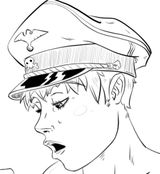
Values are meaningful, important, and something you should be settling with yourself even in your meatspace reality; preferences are something entirely different. Just because you would prefer to follow all trans creators, there will not be any guarantee that the trans creators you follow will have the same values that you have. This becomes increasingly apparent when you get into kink spaces in which the subject matter is increasingly taboo such as fashkink or loli/shota content. Though your preference may be for Nazi uniforms, your values are likely anti-Nazi—not always true for other Nazi Uniform Kinksters, catch my drift? If you’re in a fashkink space, your carrd might say “No Neo-Nazis” because you want to outwardly portray that value and keep them out of your space. But if you prefer Waffen-SS over Wehrmacht, that’s something you’re going to have to curate for yourself.
In fandom spaces, ships are preferences. They are not values. Kinks are preferences. They are not values. Aesthetics are preferences. They are not values. Making call-outs and disturbing the Twittersphere’s peace over someone’s preferences makes everyone around you realize that you haven’t got your priorities straight—values over preferences. There is absolutely no link between these two things and anyone who’s been in a relationship with someone who loved all the things they loved but couldn’t be with them because their values were different can tell you it’s unfortunately a reality.
This brings us back to boundaries—setting improper boundaries is setting yourself and your fandom up for failure. Setting improper boundaries around topics of discussion (you must be this tall to ride) and throwing accusations around when those unreasonable boundaries are inadvertently broken (especially when they were not duly labeled and were meant to be assumed) is a type of boundary crossing in itself. It is essentially a type of broken bottle scam. A target is chosen, induced to breaking the invisible and unreasonable boundary, and then when they do they are hounded into releasing information about themselves to prove to the “audience” that the original point-maker is a hapless victim. If you are the original point-maker and your entire argument rests on the discrediting of anyone who argues against you (they’re racist, they’re pick-mes, they’re brainwashed, they’re ableist, they’re nazis etc because of [insert aspect of their identity you bullied out of them with your scam]) then you’re one of the reasons your fandom is dying and less art is being made for your ship. Sorry, but that’s the god’s honest truth. Nobody wants to be in a fandom making art for people who are eventually going to set them up to be the mark in a clout scam.
Identifying appropriate boundaries to set and identifying when your personal boundaries have been crossed (interrogations, othering, dogpiles, and doxxing) are part of creating a healthy personal environment for you to function within fandom. They keep you from becoming toxic (by allowing you to rationally determine when your personal boundary needs to be enforced) and they also keep you from interacting with the outside toxic parts of your fandom (by allowing you to recognize when others are placing irresponsible and irrational boundaries). When you know that your boundary is rational and appropriate and based on your personal values, it is easier to enforce that boundary, hitting the block button, using tools like Mega Block, and unfollowing or muting. This isn’t to say you can’t block on preference (absolutely do that) but it enables you to identify properly when someone has actively stepped across your boundary and how you can make certain not to do that to anyone else.