Art as a Moral Neutral
I think I have to preface this post by saying that I am steamed. I even waited to try to write it when I wasn’t so irrationally angry, but the irrationality has persisted. I probably sound upset in almost all my newsletters considering the type of language I use and how acidic they can get, especially near the ends…but this is a whole ‘nother animal. This is a bone-deep anger. It should be. After all, it fits within the larger context of global, national, and personal events that have sparked a bone-deep anger in tens of thousands of people across countries and oceans. It’s part of a narrative surrounding one of the greatest, most devastating revelations of our time; the utter depravity and the despotism that has risen from it; the worst proven conspiracy in American history: Epstein.
It’s difficult for most of us to wrap our heads around things that are “beyond” our ability to empathize. Though some people may insist that their empathy is boundless, most of us with a decent amount of emotional maturity and awareness can recognize that a human’s primal psychological defense arsenal includes a little something called “doubt.” In order to prevent ourselves from going mad with the ability to imagine heinous acts against our own bodies, we must (we must!) rationalize that such acts will not or could not occur to our selves. We’ve talked in previous newsletters about Sue Grand’s work in The Reproduction of Evil where she explains that to witness pain is to doubt it and to experience it for oneself is to have a revelation—we cannot (it is impossible) to precisely conceive of the horrors experienced by victims of the rich and powerful upon Little Saint James Island (colloquially “Epstein Island”). When QAnon conspiracy whack jobs said things like “There’s a cabal of rich pedophiles eating children,” there was an immediate reaction to that which consists of normal people giving each other sideways glances to communicate a silent “uh oh, someone forgot their meds this month” and wouldn’t you know it, the seemingly rabid dogs were right...just…facing the wrong direction.
Facing the wrong direction seems to be a pattern here. Whether it’s QAnon believing in a false deity who turns out to be the very pedophile cabal member they vowed to fight against or so-called rational people pointing toward everything except the responsible parties involved, this trend has got me fucking heated. Recently, I came across a number of people on TikTok and other social media platforms who have turned toward the latest of the Epstein “discoveries,” those being elements of his art collection. Relatively speaking, Epstein’s art collection (that I’ve seen) is fairly mundane and no where near what everyday internet denizens have witnessed in just the questionable taste of works by, for example, Shadman. It is the context that the art exists within that determines how average people interpret it when it’s placed in front of them. Without the context of “This art belonged to Jeffery Epstein,” most of the disgust toward that art would likely fall away—or at least become appropriate for the piece’s intention.
The artwork that often sees the most derision and disgust is a piece by Damian Loeb called “Little Miss Pink Tomato.” Most folks on TikTok or similar platforms cannot show you this artwork because it likely falls outside the scope of acceptable imagery on social media. Though it is not overtly sexual, the elements of the work are designed to provide a disturbing sexual quality imposed upon the subjects: prepubescent children. Barely above toddler age, the subjects of the 1995 painting are eight little girls dressed in children’s style bathing suits, mostly small, ill-fitting bikinis that show off their shapeless forms as they stand before a faceless dark crowd just beyond the too-bright pageant lights. Loeb’s use of light here is telling: the way it shines over the girls’ tanned skin almost like they’ve been oiled and the backs of the lights in the foreground insist upon an unseen audience—of which we are a part. As if these elements weren’t enough to drive home the point of the work, Loeb takes us one step further into the distinct horror upon which we gaze. Behind the girls, the backdrop of the stage is not that of glittering pageant decor but almost appears as though it were some leftover of a previous production (The Wizard of Oz, perhaps?) but the image is purposeful and poignant—that of a black, twisting tornado barreling across a rural landscape and tearing through tiny structures, the debris flying haphazardly through hazy air as it rips up once-unmarred farmlands and destroys dozens, if not hundreds, of lives in only minutes.
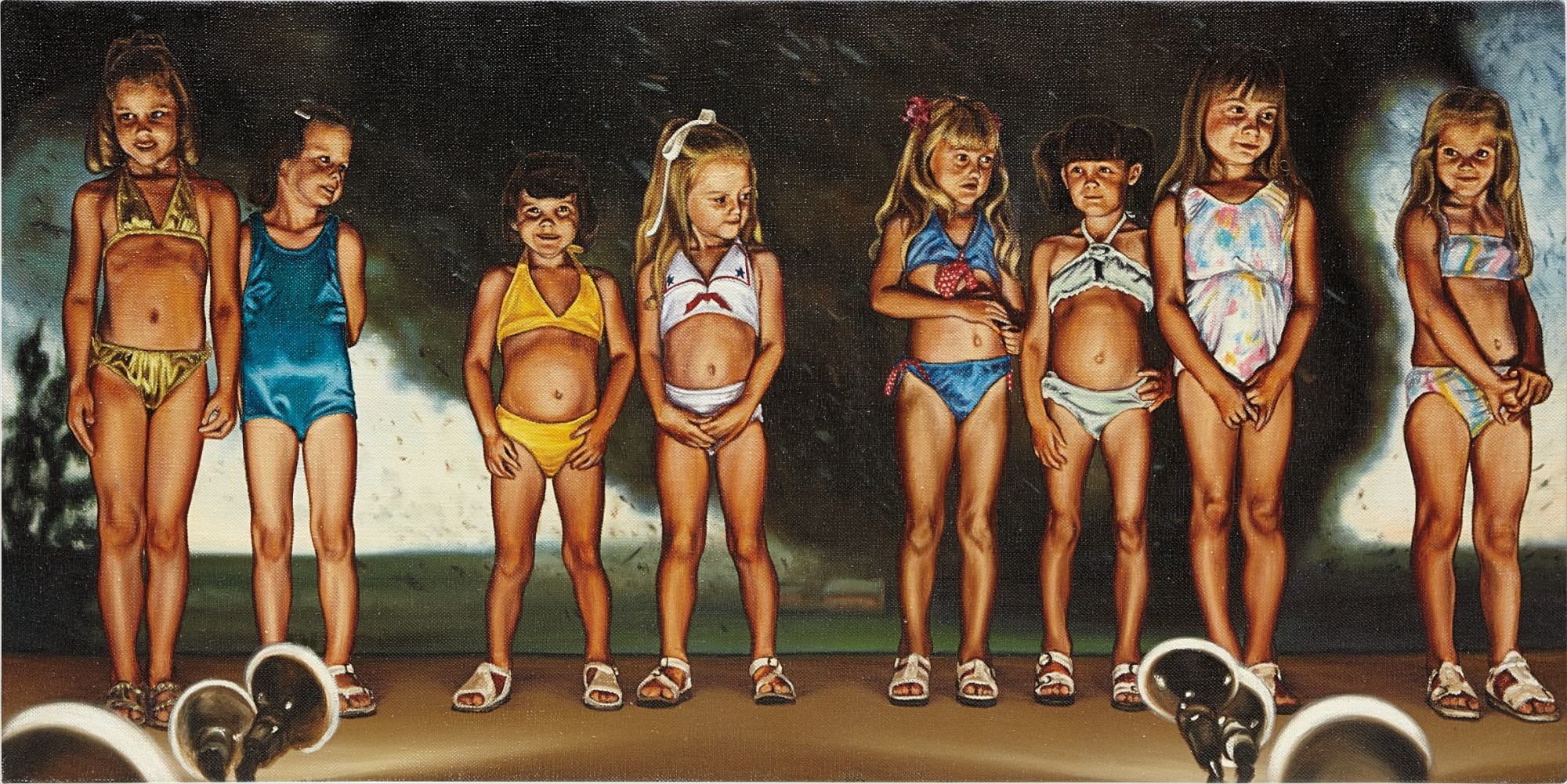
Loeb’s combination of the background, foreground, and subject is a descent into a nightmare of the banal. It’s something the artist is relatively known for, being able to put together elements of a scene that invoke a simmering and unsettling terror that is sometimes difficult to pinpoint due to the complex nature of our cultural understanding. Each of his choices, especially in “Little Miss Pink Tomato,” plays upon generational learning, our historical past, and upon the direct and focused fear we have of the uncontrolled. I don’t generally hold people’s hand through art, but it’s almost that I feel I have to in order to get my point across. Some art tells you things, most art asks things of you. What Loeb’s art is asking of you here is to understand that, in terms of damage, child beauty pageants are on the same level of destruction as a full blown, havoc-wreaking, EF5 tornado. This piece is asking you to acknowledge and look at and understand your complicity in (placing the viewer in the foreground as the audience is again a choice) the abject destruction of little girls through the objectification of their child bodies.
Epstein likely did not misunderstand this art the way I see people misunderstand it today. He knew what the art was asking of him. He simply said “No.” Epstein did not find horror in the horrible or terror in the terrifying. Someone objectively evil in such ways did not accept the role Loeb provided for us as viewers: that of an unsettled observer. He may have identified instead as the tornado or perhaps even the pageant judge…but really…what’s the difference? Whatever Epstein got out of that artwork did not change what the art asks of its viewer or the elements that exist within it to lead you to that question. No one man’s ownership of a piece of art can change the intent or the thematic elements that lie within it. The derision I have seen for “Little Miss Pink Tomato” is unearned and ultimately unwarranted, coming from people who are clearly having a hard time putting artistic puzzles together that might as well come with fully-rendered and detailed instruction manuals. It helps, of course, that they can’t show the art itself for perhaps someone out there might ultimately tell them they’re wrong if they did.
Like I am now.
A TikTok “influencer” with 21.5k followers (and yet not a whole lot of engagement, hmm) called arthistoryabby posted a video where the very first thing she states is “If you can live comfortably with sick weird art, then you are a sick weirdo.” She then goes on some diatribe detailing her own personal history with “Little Miss Pink Tomato” and how sickened she was with it when it came through her place of work where she conditioned art that was on consignment before sale at auction. I have to be honest, I’m fairly galled by the fact that someone who worked in an art-adjacent industry and who prides themselves on that aspect of their life enough to call themselves “arthistoryabby” would be so utterly clueless as to miss not just the individual painting’s overt statement, but also dismiss the broader themes present in most of the artist’s work. I had never even heard of this art piece before that video came across my For You Page (“FYP”) and in the course of just a ten second Google search I could tell this woman was full of shit and full of herself, talking about art she just didn’t like. Newsflash: you’re not supposed to like it. In a follow up video she states that she’s grateful that no one has tried to “big brain explain” the art to her because she “doesn’t have the time,” which is such a thing to say when you’re the one who brought it the fuck up in the first place and spoke from a place of abject ignorance. Turns out, I can small brain explain the art, as I’ve clearly demonstrated already, and it took me about two minutes to type what I knew immediately after seeing the work for the first time and doing a small bit of research into Loeb and his portfolio.
Abby, you’re facing the wrong direction. Anyone who can agree with Abby is also facing the wrong direction. A bad interpretation of a good piece of art does not make the art bad, and an evil man having a clearly twisted perception of an artwork cannot destroy what it is asking you to consider when you look at it. That the work creeped Abby and others out when they saw it is a testament to how well Damian Loeb did his job. Discomfort is what you were meant to feel. That Epstein didn’t feel that doesn’t change the meaning nor intent and the assertion that this art is “sick” or “weird” is the language of censorship and fascism. Epstein spent the better part of his life manipulating powerful people into the positions they’re in today that have led us down the road to despotism, are you really gonna carry all that water for them now?
I understand that this is part of the primal psychological defense mechanism—the inability to acknowledge that real people committed real acts against real children. Doubt. It’s a whole hell of a lot easier to pretend that something “made them” do that or that there was a “sign” that should have been easy to see that betrayed the monster dressed as a man…but reality is a whole lot messier than that, and we can’t point at art every time something bad happens and lie to ourselves and say “if that didn’t exist, we’d all be better off.” Life just doesn’t work that way and I’m tired of people who should know better than that screaming that it does. It undermines accountability. It allows predators an “out.” It allows for people who don’t know better to pretend that something outside of a person can “make” evil things happen and that is something we can’t afford right now. All inhumanity stems from humanity and we have to recognize that our enemies now are only human and so are we. Do not fall for this nonsense.
Art is a moral neutral. Evil is a human choice.
Choose wisely.